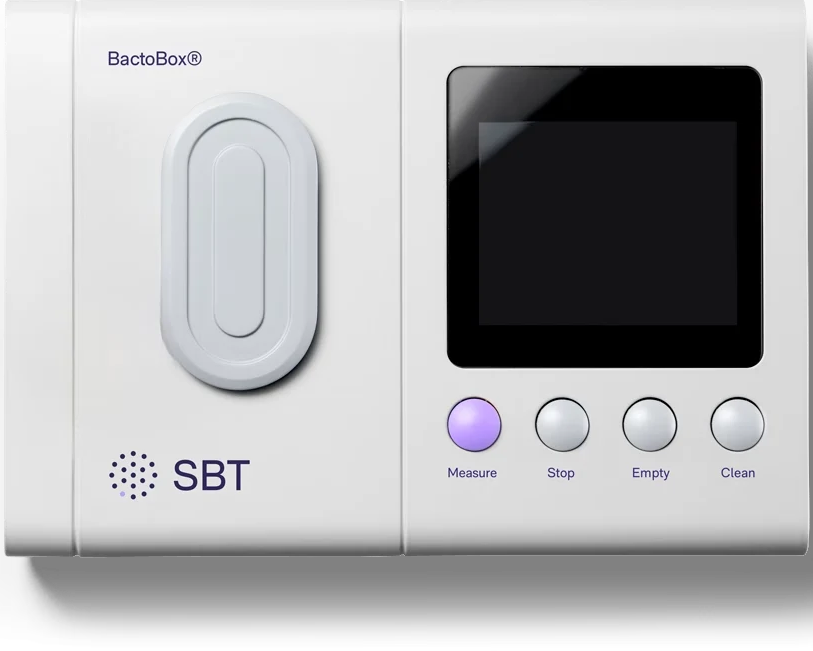
THE PROBLEM
Your plate count does not match the dose you planned
You set the dose from OD or McFarland. The plate count arrives one to seven days later, and it is off.
THE SOLUTION
Count the cells before you dose
1Dilute your stock
Into the measuring range
2Measure
About two minutes
3Calculate
The dilution to your target dose
4Dose
At the concentration you planned
Doses are set from the measured stock, not read directly.
When you must commit to a dose before the experiment runs
Dosing animals and larvae
Mice, fish or insect larvae. Know the dose on the day you infect.
Setting an MOI
On cell lines, organoids and tissue models.
Preparing test suspensions
For challenge and efficacy tests in development work.
WHY OD FAILS YOU
Dilute to the same OD, and you get a different dose
One OD unit does not hold a fixed number of cells. In LB, one OD unit of E. coli holds 5 × 10⁸ to 2 × 10⁹ cells/mL, depending on when the culture is caught.
E. coli in LB, one culture sampled as it grew. In an active culture, cells/mL tracks CFU/mL. SBT Instruments data.
WHY IT WORKS
Dose viable bacteria, counted in two minutes
In an active culture, every cell BactoBox® counts also forms a colony. So the number you dose is the number of viable bacteria.
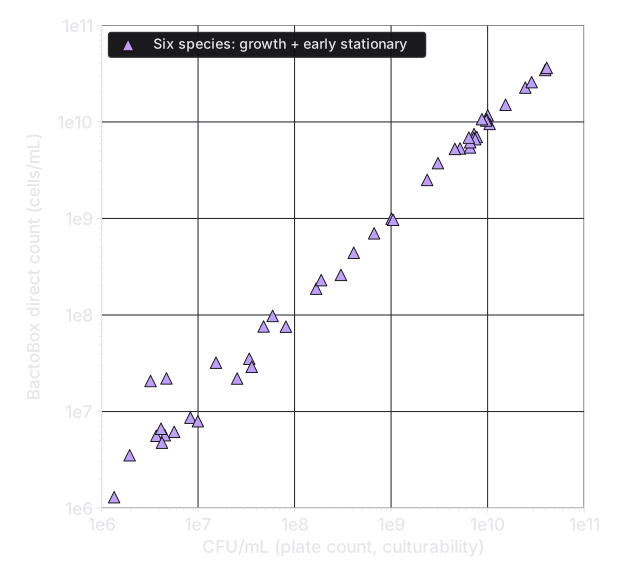
Measure cultures above 107 cells/mL.
Two ways to have an active culture when you need it
Subculture in the morning
Measure a few hours later, in exponential phase.
Seed the overnight culture
So it is still active when you arrive.
PROOF
Peer-reviewed studies that already set their dose with BactoBox
Nature Communications 2025
MiceCounted L. reuteri to set the oral dose in germ-free mice, in a study of the gut and behaviour.
Park et al., POSTECH, South Korea
PNAS 2026
Insect larvaeSet the S. aureus inoculum for Galleria mellonella killing assays.
Mattingly et al., Emory University, United States
Gastroenterology 2025
Human cellsCounted F. prausnitzii to standardise the dose for stimulating human monocytes.
Danne et al., Sorbonne Université, France
GOOD TO KNOW
Frozen, dried or stored stock
Holds cells that no longer form colonies, so the count and CFU differ. Grow an active culture first.
Organisms that clump
Get in touch, and we will look at your organism with you.
Try it on your next inoculum
Contact us to discuss how this works for your organism.