
Turning OD600 into a cell number
This article walks through the steps of building an OD600-to-CFU calibration curve, and the pitfalls that come with it. It then introduces a method that avoids those pitfalls, by measuring the cells directly.
Most cultivation labs read growth through OD600, because it is fast and runs at the bench. What many of them actually want is a cell number, often the colony-forming units (CFU) they would get from a plate count. The usual bridge between the two is a calibration curve that converts an OD600 reading into a CFU-equivalent. The curve is easy to build once and convenient to reuse. The difficulty is that the relationship it captures is not stable, so a curve built under one set of conditions quietly stops being correct under another. This article covers how the OD600-to-CFU calibration is normally built, why OD600 and CFU stop tracking each other, and how a direct cell count changes the picture.
How to build an OD to CFU calibration curve
The procedure itself is straightforward. The care is in the sampling.
- Grow the strain in the exact medium and conditions you intend to use the curve for. The curve will only be valid for those conditions, so match them from the start.
- Through the run, pull paired samples across the whole density range you care about, several points per order of magnitude, from early growth into stationary phase.
- For each sample, read OD600 and plate for CFU. Dilute the sample so the OD reading falls in the spectrophotometer's linear range, then multiply back. Plate in replicate so each CFU point is an average of several plates rather than a single one[2]. Make sure to cool the CFU samples when pulled, since fast-growing organisms can rapidly skew your calibration results.
- Plot CFU/mL against OD600 and fit the relationship over the density window you will actually work in, rather than forcing one line across the whole curve. The fit holds only for that window.
- Record the strain, medium, and conditions next to the curve. That label is part of the result.
Done carefully, this gives a usable conversion for that strain, in that medium, over that range. The trouble starts when any of those conditions change.
Where the calibration slips
OD600 is turbidity, not a count. The signal responds to cell number, but also to cell size, cell shape[3], and any non-cell particulates in the light path[1]. The number of cells behind one unit of OD600 is therefore not a fixed conversion factor.
The conversion factor moves across a single growth curve. In the E. coli runs in Figure 1, the number of cells behind one OD600 unit climbs roughly five- to sevenfold from early growth to late exponential phase, the upward slope of every curve. The main driver is cell size, which does not hold constant through exponential growth and often begins to fall well before a culture leaves that phase[4]. Smaller cells scatter less light, so more of them are needed to reach the same OD600 (cell size is not plotted in Figure 1, but it was measured alongside every count in these same runs, and it falls across the range sampled here). A single conversion factor cannot be right at both ends of the same run. Reused across the whole curve, the way a standard-curve slope usually is, it is off by several-fold, overstating the count early and understating it late, which flattens the very growth curve you are trying to read.
The calibration factor also moves between conditions, which is the larger problem. Figure 1 follows the same E. coli strain grown in four different media and plots the conversion factor itself, the number of cells behind one unit of OD600, against the OD600 reading. The curves sit at different heights, so at a typical calibration density, around OD600 = 1, the factor differs about fivefold between media. Because a direct cell count agrees closely with the plate count through exponential and early stationary phase (R² above 0.99 across six species[6]), this cells-per-OD factor is, for practical purposes, the OD600-to-CFU factor a calibration is built to capture. A curve built in one medium misreads another by roughly that margin, and a change in strain, aeration, or temperature shifts it again. The growth rate is not spared either. In these cultures the exponential rate read from OD600 came out 20 to 32 percent below the rate from direct counts, by a medium-dependent margin.
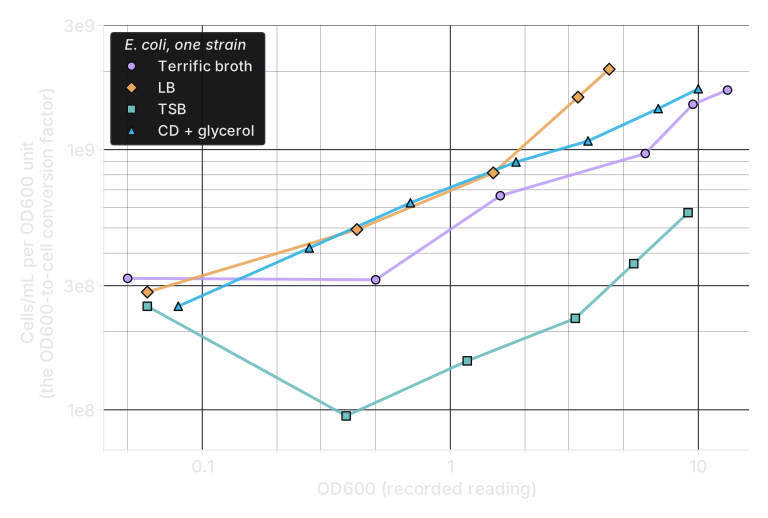
Diluting into the linear range keeps the OD measurement itself honest[5], but it does nothing for the biology, so the conversion factor still drifts. The CFU axis carries its own variability too, because plate counts depend on the plating method, undercount when colonies merge on a crowded plate, and scatter from plate to plate[2]. Both sides of the calibration move, which is why a curve is best understood as a snapshot, valid only for the exact strain, medium, and conditions it was built in.
A direct count skips the correlation
The reason a calibration curve is needed at all is that OD600 does not measure cells. BactoBox® does. It counts whole bacterial cells one at a time and reports the concentration directly in cells/mL, so there is no proxy to convert and no per-condition curve to rebuild. When the medium or the strain changes, the measurement does not need recalibrating, because it was never a proxy in the first place. For how that count is produced and what it does and does not represent, see Understanding BactoBox® cell counts.
Reading cells directly does not throw away the connection to CFU. It has been measured. In a performance-qualification study across six bacterial species, BactoBox® cell counts tracked CFU on a close-to 1:1 relationship through exponential and early stationary phase, with R² above 0.99[6]. Figure 2 shows that agreement holding across more than four orders of magnitude. So through the range where an OD600-to-CFU curve is built and used, a direct count returns the same number the plate count would, without the calibration step in between.
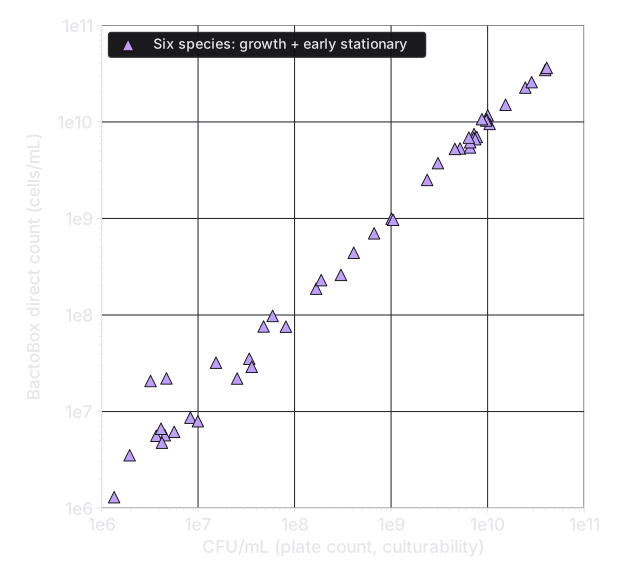
The practical effect is that the cell number is available in about two minutes, with no operator-dependent counting step, and it stays comparable from run to run and medium to medium without a calibration to maintain. That is what makes a series of direct counts a clean way to read growth kinetics. A growth rate calculated from cells/mL is an unambiguous measure of how fast the population is dividing, which OD600 cannot give because its signal also moves with size and morphology.
A practical takeaway
If you keep an OD600-to-CFU calibration, treat it as condition-specific, and rebuild it whenever the strain, the medium, or the cultivation conditions change. If you would rather not maintain a calibration at all, measure the cells directly and keep CFU for the questions only it answers, such as culturability or compendial release. And if you are set on tracking your runs with a calibrated OD curve, you can at least drop the plate counts and build the curve against a direct cell count instead of CFU to save workload. For more on the proxy itself and where it is and is not trustworthy, see Understanding OD600.
References
- [1] Beal J, Farny NG, Haddock-Angelli T, et al. Robust estimation of bacterial cell count from optical density. Communications Biology. 2020;3:512. https://doi.org/10.1038/s42003-020-01127-5
- [2] Martini KM, Boddu SS, Nemenman I, Vega NM. Maximum likelihood estimators for colony-forming units. Microbiology Spectrum. 2024;12(9):e03946-23. https://doi.org/10.1128/spectrum.03946-23
- [3] Stevenson K, McVey AF, Clark IBN, Swain PS, Pilizota T. General calibration of microbial growth in microplate readers. Scientific Reports. 2016;6:38828. https://doi.org/10.1038/srep38828
- [4] Åkerlund T, Nordström K, Bernander R. Analysis of cell size and DNA content in exponentially growing and stationary-phase batch cultures of Escherichia coli. Journal of Bacteriology. 1995;177(23):6791–6797. https://doi.org/10.1128/jb.177.23.6791-6797.1995
- [5] Myers JA, Curtis BS, Curtis WR. Improving accuracy of cell and chromophore concentration measurements using optical density. BMC Biophysics. 2013;6:4. https://doi.org/10.1186/2046-1682-6-4
- [6] Jordal PL, González Díaz M, Aalund F, Skands G. Performance qualification of impedance flow cytometry as a rapid in-process control proxy for colony-forming units in bacterial fermentation processes. Journal of Microbiological Methods. 2025;238:107284. https://doi.org/10.1016/j.mimet.2025.107284