
An increase in optical density is easy to read. The number went up, so there must be more cells. But that does not follow. OD600 rises with cell number, and it rises again when the same number of cells get bigger, and it cannot tell the two apart[1].
Cell size is part of what makes OD600 ambiguous. But cell size is also a process signal in its own right. In mammalian cell culture, mean cell diameter is tracked as a routine read on how a culture is doing. Microbial process development has rarely had that lens, because following bacterial cell size has meant microscopy or flow cytometry, and neither sits easily beside a running fermenter. BactoBox® measures it next to the direct cell count, from the same reading, in about two minutes.
This article covers what cell size means for a bacterium, what the signal carries, and how to read it beside the count.
What OD600 hides
Optical density sums everything in the light path. Cell number, cell size, morphology, the optical properties of the medium, and any debris. One number comes out, and it never says which of those moved. Understanding OD600 works through the signal and its limits in full.
The practical consequence is that two runs can sit on the same OD600 curve with materially different cultures behind them.
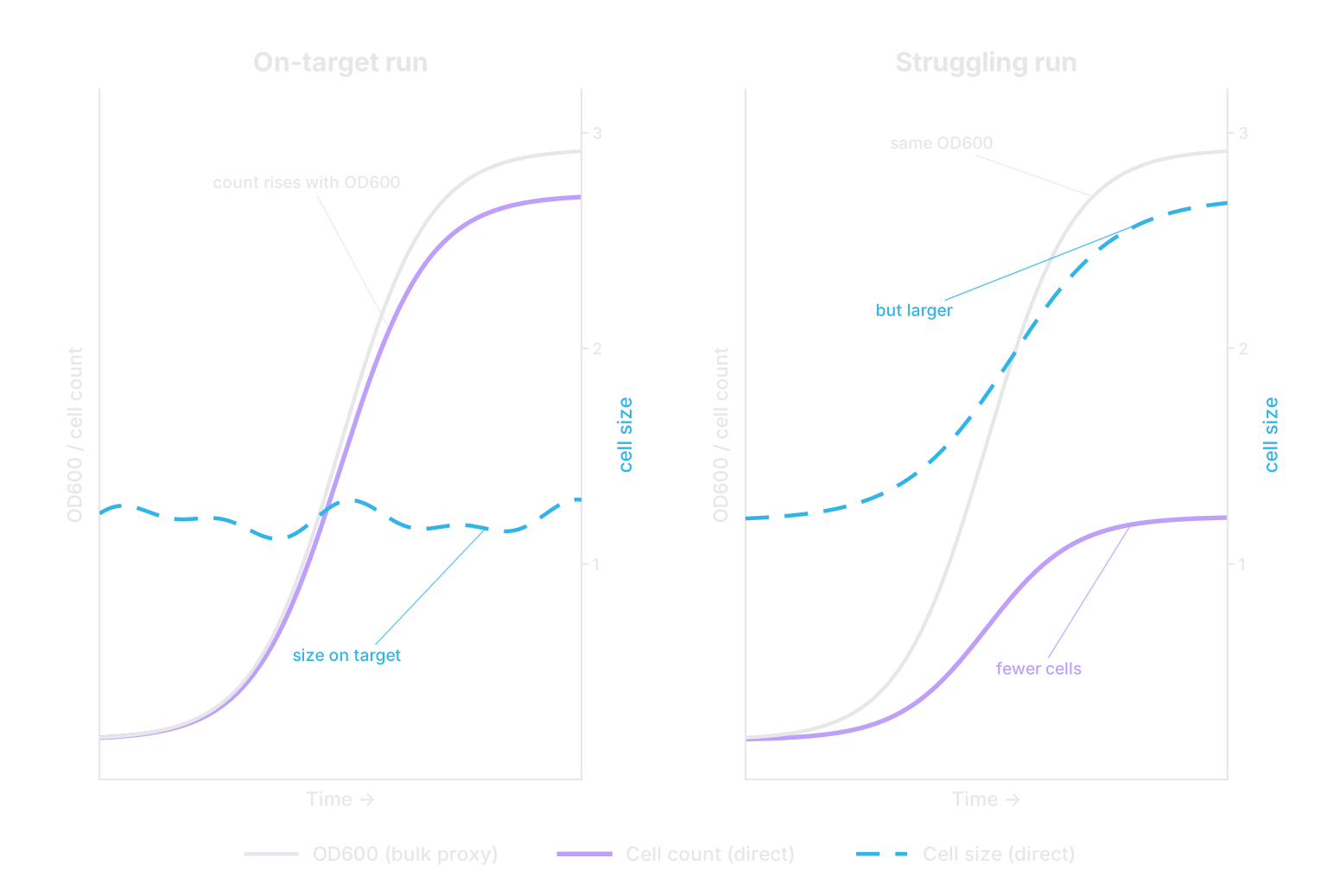
The error is silent. The OD curve looks clean, the run is internally consistent, and nothing inside the OD data says which of the two you have.
The same ambiguity sits inside a single run. Cell size falls as a batch culture proceeds, so more and more cells are needed to reach the same OD600 reading, and one reading cannot be turned into a cell number with a single factor. It does not move in exact proportion either, because OD600 responds to cell shape and refractive index as well as size[1]. In one series of E. coli runs the number of cells behind one unit of OD600 climbed five- to sevenfold between early growth and late exponential phase. Building an OD600-to-CFU calibration curve works through that data.
Size is best described as volume, not length
Bacteria come in many shapes, from rods to spheres to chains, and they change shape as conditions change. A length, or the longest dimension, does not compare cleanly between cells, because two cells of the same length can hold very different amounts of material.
The quantity that does carry across shapes is the total volume of the cell. That is also what impedance flow cytometry, the principle behind BactoBox®, senses. As each cell passes the sensor, the size of the electrical signal scales with its volume[2]. BactoBox® reports this as Cell-Impedance-derived siZe Estimate (CIZE), the average spherical-equivalent diameter of the counted cells, which is the diameter of a sphere holding the same volume as the cell. Because the number encodes a volume, a small change in CIZE is a larger change in size than it looks. Cells in a population at CIZE 2 µm hold roughly eight times the volume of cells at CIZE 1 µm. Understanding BactoBox® cell counts covers how the count and the size are produced.
What the size signal carries
Watching cell size is routine in mammalian cell culture. In Chinese hamster ovary (CHO) fed-batch production, a distinct cell-size-increase phase is documented[3], and shifts in mean cell size track changes in how much product the cells make[4]. Size is treated there as information about the state of the cells, not only their number.
The same is true for bacteria. Cell size is a read on the physiological state of the culture[5]. A cell size that holds still through a stretch of a run points to cells that are working the same way through it. A cell size that moves says something in them has changed, whether that is a shift in metabolism, a response to what is left in the medium, or the start of a problem. The reading does not say which of those it is.
Through a batch cultivation, cell size moves a great deal. In E. coli batch cultures in rich media, average cell size starts to decrease during exponential growth, well before the culture leaves it[6]. In our own runs, across six media, the mean cell volume falls four- to tenfold between its early peak and late exponential phase. Over the first six doublings of one of those runs the cell count is a straight line on a log axis with no detectable change in rate, while cell volume falls by a factor of two and a half. So the cells are changing while the growth curve says nothing has. Exponential growth is not the same as balanced growth. A culture can divide at a constant rate while what is inside the cells keeps changing[5][6].
A fed-batch process is a different problem. The feed is there to hold the culture in one physiological state, so while the feed is running to its profile the expectation is a cell size that holds still. A size that moves anyway says the cells have left that state, and in the classic shift experiments that move arrives well ahead of any change in the division rate[7]. On a process that is still being tuned, that is an early warning.
Cell size moves in both directions and for several reasons. Starvation pulls the cytoplasm away from the cell wall as the cell loses water[8], cells growing slowly in poor conditions are smaller overall[5], and a block on division, such as the SOS response to DNA damage, lets a cell keep growing and elongate[9][10].
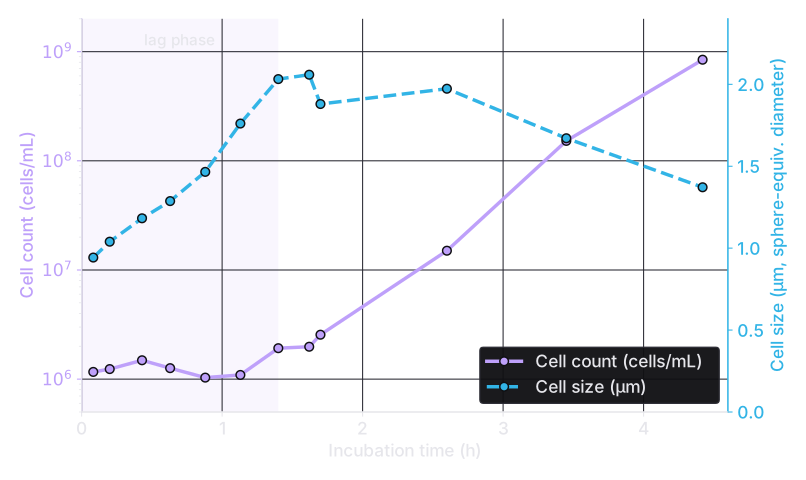
The signal shows up early, ahead of the cell count itself. Cells are known to grow in size during lag phase, before any of them divide[11]. The figure below is one real E. coli batch culture, with the direct cell count and the cell size taken from the same BactoBox® readings. Through the lag phase, roughly the first 1.4 hours, the cell concentration holds near the level it was seeded at, and the population is not yet expanding. Cell size climbs steeply over the same window, from about 0.9 to 2.0 µm, which is roughly a tenfold increase in cell volume. Cell size then falls away through the exponential phase that follows, from about 2.0 to 1.4 µm while the count rises more than three hundredfold, which is a little over a threefold drop in cell volume.
How to read the size trace
Four habits make the size trace usable.
Interpret size and the count together. Changes in cell size add important information about your culture. A count that is flat while size climbs is usually a culture coming out of lag. A count that is flat while size is flat too is a culture that is not changing.
Read the trajectory, not the value. There is no target CIZE. What carries information is how size moves through a run, and how that compares with the same process last time.
Do not read direction as quality. Smaller is not worse and bigger is not better. Cells shrink under nutrient limitation and elongate when division is blocked[8][9], and both are departures from a culture that is growing as intended.
Establish the normal trace first. Run the process you already trust and record what size does through it. A departure only means something once you know what the process normally does.
Why this matters in fed-batch fermentation
That makes cell size a feed-design signal. A feed that is too rich, too lean, or mistimed pushes the cells off the state the process was tuned for, and a size trace read beside the count shows the move directly rather than through a proxy. Followed through a run, it reads how the culture answers a feed change, which is information a feed-rate profile is currently tuned without. It is also where a feed that has drifted shows first.
In a fed-batch E. coli process, the textbook example is acetate overflow. When carbon comes in faster than the cells can oxidise it, they spill the excess into acetate, and the acetate holds back both growth and product formation[12]. By the same reasoning, the cells change state before the count shows it, and cell size is where that shows. Telling that apart from the size rise of a culture accelerating normally is what the normal trace above is for.
The organism, the medium and the feed settle how large the size response is, how fast it arrives, and whether it is large enough to read. That is what the first runs on a new process are for.
Closing
For decades the growth curve has been a single quantity followed over time, and for most bacterial cultivation work that quantity is OD600[1]. Cell size adds a second one to the same curve. It gives an understanding of what state the cells are in, what they are doing, and, because size moves first, where the count is going next, from the same reading and at the same cadence.